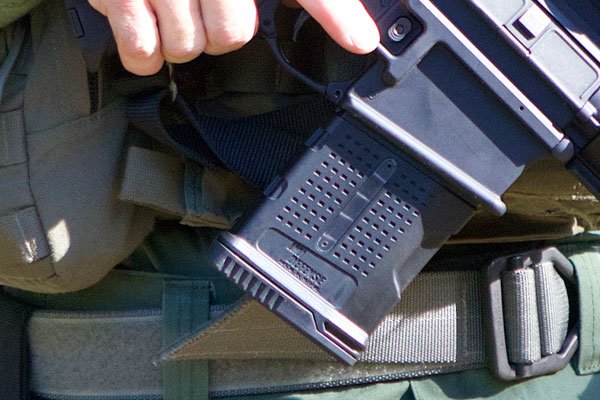
Every rail decision on a carbine is really a mounting-standard decision. Picatinny is the older interface: a continuous 1913 rail that any clamp will grab, at the cost of weight and sharp edges. M-Lok® is the newer one: negative slots that accept a T-nut, lighter and smoother, with a smaller but now mature accessory ecosystem.
Weight
On the same carbine, a full-length Picatinny handguard weighs roughly a third more than its M-Lok® equivalent at the same length. That is felt in the support hand after a few hundred rounds, and it is why most new builds start with M-Lok®.
Repeatability
Picatinny wins for anything that has to come off and go back on at the same zero: lasers, some optics, bipods you move between rifles. An M-Lok® T-nut will return to the same slot, but a clamp on a Picatinny rail returns to the same slot and the same recoil lug.
Availability
In 2026 nearly every accessory ships in both interfaces, and short Picatinny rail sections mount to M-Lok® in seconds. So the honest answer: M-Lok® for the handguard, with a Picatinny section wherever you need a repeatable mount.
What we sell
Both. Every IMI rail lists its interface, its weight in ounces and the gas-block clearance we measured. Pick once, buy once.