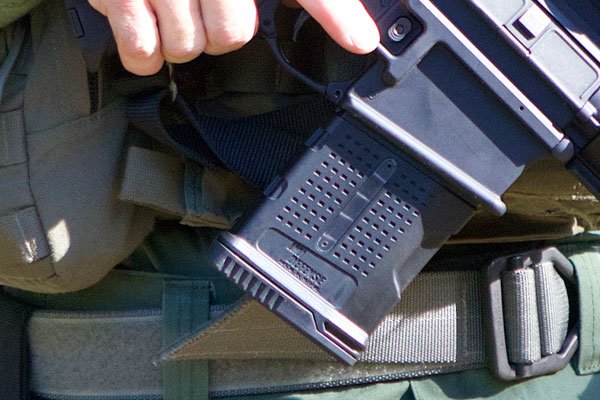
A polymer magazine has two jobs: hold pressure on a column of cartridges, and present the top round at exactly the angle the bolt expects. Both jobs get harder when the body is hot. Polymer creeps under sustained load at temperature, and the place it creeps first is the place with the least material and the most stress — the feed lips.
The test
Sixty magazines, loaded to capacity, heat-soaked for 48 hours. Then dropped from six feet onto concrete, on the feed-lip corner, forty times each. Then fired. We are not looking for a magazine that survives — we are looking for the drop number where the batch starts to fail, and the geometry that fails.
What failed
Early bodies failed where the witness window met the mold seam: two stress concentrators in one place. Moving the window a few millimeters off the seam removed the failure. It is the kind of change nobody notices on a spec sheet and everybody notices on a hot range.
A test nobody fails is a test nobody needed to run.
Why we publish this
Because the failures are the useful part. A magazine listed with a field record tells you how many rounds, at what temperature, how many drops, and how many units out of the batch did not make it. That is information you can compare. “Premium quality” is not.